
Docker: Difference between revisions
| Line 27: | Line 27: | ||
Docker files consists of <INSTRUCTION> <ARGUMENTS>. The first instruction is always | Docker files consists of <INSTRUCTION> <ARGUMENTS>. The first instruction is always | ||
FROM < | FROM <BASE_IMAGE> // e.g. base image FROM Ubuntu | ||
Then the RUN instructions gets all dependencies e.g. | Then the RUN instructions gets all dependencies e.g. | ||
RUN apt-get update | RUN apt-get update | ||
Revision as of 17:25, 9 January 2022
Resources
- Docker Hub Public Repository
- Docker Youtube Tutorial
History
Docker container technology was launched in 2013 as an open source Docker Engine. It leveraged existing computing concepts around containers and specifically in the Linux world, primitives known as cgroups and namespaces. Docker's technology is unique because it focuses on the requirements of developers and systems operators to separate application dependencies from infrastructure. Success in the Linux world drove a partnership with Microsoft that brought Docker containers and its functionality to Windows Server (sometimes referred to as Docker Windows containers).
Concepts
- Docker runs on a Host Operating System.
- A Docker Container is a lightweight, standalone, executable package of software that includes everything needed to run an application: code, runtime, system tools, system libraries and settings, but in difference to VMs it does not include the (guest) OS layer (difference between Docker and VMs see here). Containers isolate software from its environment and ensure that it works uniformly despite differences for instance between development and staging. Docker container have their own (temporary) file system.
- A Docker Container is running on the Docker Host. Multiple container can run on the same host. The Docker Daemon as part of the host manages the containers
- The Docker Client steers the daemon and is accessed via terminal (Powershell, Linux shell, …).
- A Docker Image is a unmutable template with instructions for creating Docker containers and is build using a file called Docker file. The Docker image is stored in the Docker Hub or in a registry.
- Docker image ---> commands (pull from repository, …) ---> Docker container
- Images are stored in a registry, the public registry is Docker Hub.
- Docker Volumes are used to store data and to share data across containers.
Creating Images
- create a file called 'Dockerfile'
- run
docker build Dockerfile -t <IMAGE_NAME>
// docker push <IMAGE_NAME>
Dockerfile
Comment lines starts with # (hash).
Docker files consists of <INSTRUCTION> <ARGUMENTS>. The first instruction is always
FROM <BASE_IMAGE> // e.g. base image FROM Ubuntu
Then the RUN instructions gets all dependencies e.g.
RUN apt-get update
Then copy source code e.g.
COPY . <CONTAINER_DIR>
Define default command
CMD ... // e.g. 'CMD sleep 5' or 'CMD ["sleep","5"]
or
ENTRYPOINT["<COMMAND"] // e.g. 'ENTRYPOINT ["sleep"]' and call it with 'docker run <IMAGE_NAME> [<ENTRYPOINT_PARAMETER>]
Volumes
- Volumes are folder on the host which are mounted to a container.
Networks
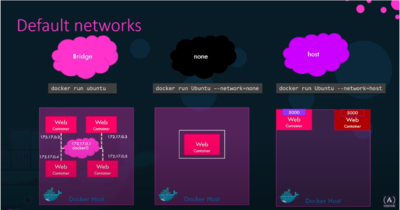
- default networks
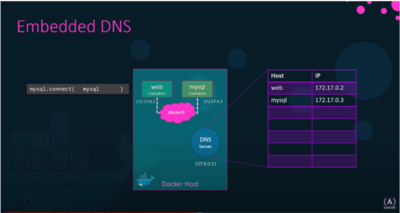
- the docker engine has a internal DNS server


Commands
Docker
// general options
-H=<REMOTE_DOCKER_ENGINE>:<PORT> // e.g. docker -H=<IP>:<PORT> run nginx
docker exec
docker image (ls | prune | remove <IMAGE_NAME>)
docker images // lists all images
docker inspect <CONTAINER_NAME>
docker log <CONTAINER_NAME>
docker network create ...
docker network ls
docker ps [<OPTIONS>] // lists all running containers
// -a all e.g. all containers in exited state
docker rm <CONTAINER_NAME>
docker rmi <IMAGE_NAME> // deletes an image
docker run [<RUN_OPTIONS>]  <IMAGE_NAME>:<TAG> [<COMMANDS>] [<ARGS>] // runs an image
// RUN_OPTIONS are:
// --cpus=<NUMBER>
// -d detach, run in background
// -e <ENV_VARIABLE_NAME>=<VALUE>
// --entrypoint <OVERWRITTEN_ENTRYPOINT>
// -i use stdin
// --link <CONTAINER_REF>:<CONTAINER_NAME>
// --memory=<AMOUNT>
// --mount type=bind,source=<HOST_DIR>,target=<CONTAINER_DIR> // moderne volume mounting
// --name <NAME>
// --network=<NETWORK_NAME>
// -p <HOST_PORT_NUMBER>:<CONTAINER_PORT_NUMBER>
// -t attach terminal
// -v <VOLUME_NAME>:<CONTAINER_DIR>, <VOLUME_NAME> is located in /var/lib/docker/volumes/... of the host file system, this is called volume mounting
// -v <HOST_DIR>:<CONTAINER_DIR>, this is called bind mounting
// <TAG> can be a version number, default is 'latest'
// <COMMANDS> overwrite the CMD of the docker file
docker start
docker stop <CONTAINER_NAME>
docker volume (create | ls | rm | prune | …) // /var/lib/docker/volumes/<VOLUME_NAME>
Docker Compose
docker-compose up // uses docker-compose.yml
docker-compose.yml
There are different versions of the format.
// version 1
<CONTAINER_NAME>:
  [build: <DIR>]
  image: <IMAGE_NAME>
  ports:
    -
  links:
    -
 // version 2
 version: 2
 services:
   <CONTAINERNAME>
   ...

 // version 3
 version: 3
   ...
networks:
  ...