
SpringBoot
Introduction
- Framework to build microservices
- common non-functional features
- not zero code generation
- not a web or application server
- provides starter projects
- embedded server (incl. in application jar)
- externalized configuration
Concepts
- SpringBoot Autoconfiguration: by scanning the classpath
- Dispatcher Servlet
- SpringBoot Actuator (for monitoring)
Security
adding to pom.xml:
<dependency>
  <groupId>org.springframework.boot</groupId>
  <artifactId>spring-boot-starter-security</artifactId>
</dependency>
and update the project automatically sets up form-based authentication with a generated session cookie generated on the server or basic authentication with a header sent along with every request
- user='user
- pwd=see console output of server start
or set it in application.properties
spring.security.user.name=uwe
spring.security.user.password=uwe
This has to be entered just once.
Testing
<dependency>
  <groupId>org.springframework.boot</groupId>
  <artifactId>spring-boot-starter-test</artifactId>
  <scope>test</scope>
</dependency>
This integrates the frameworks JUnit, Hamcrest, Mockito,
Configuration
Application Properties
in \<Project>\src\main\resources\application.properties
logging.level.org.springframework = debug

#security configuration see here

#H2 database configuration see here

#logging configuration see here
Logging
A good description is here. The default log output is
<DATE>
To implement logging
import org.slf4j.Logger;
import org.slf4j.LoggerFactory;
final static Logger logger = LoggerFactory.getLogger(BookmarksRestController.class);  // is the LOGGER_NAME
BookmarksRestController.logger.trace(...
The general configuration in application.properties:
# a selection of core loggers (embedded container, Hibernate, and Spring Boot) are configured to output more information
debug=true

# enables trace logging for a selection of core loggers (embedded container, Hibernate schema generation, and the whole Spring portfolio)
trace=true

logging.file.name=./log/bookmarks.log
logging.logback.rollingpolicy.max-history=5
# double backslash quote for policy and logback
logging.pattern.file=%d{yyyy-MM-dd HH:mm:ss} [%thread] %-5level %logger{1}.%M{}\\(\\) - %L: %m%n
logging.pattern.console=%d{yyyy-MM-dd HH:mm:ss} [%thread] %-5level %logger{1}.%M{}\\(\\) - %L: %m%n
The specific configuration can be set according to package/class hierachy:
logging.level.<PACKAGE_NAMEn>=<LEVEL>
logging.level.<PACKAGE_NAME1.PACKAGE_NAME2>=<LEVEL>
logging.level.<PACKAGE_NAME1.PACKAGE_NAME2.CLASSNAME>=<LEVEL>
// e.g.
logging.level.com.uweheuer=INFO
logging.level.com.uweheuer.bookmarks=TRACE
logging.level.com.uweheuer.bookmarks.entities=INFO
Implementation
Main Application
see /test1/src/main/java/com/uweheuer/springboot/test1/Test1Application.java/
@SpringBootApplication
public class Test1Application {
  ...
  public static void main(String[] args) {
    SpringApplication.run(Test1Application.class, args);
  }
  ...
@SpringBootApplication
is a convience annotation that adds @Configuration, @EnableAutoConfiguration, @EnableWebMvc and @ComponentScan.
Rest Controller
import org.springframework.web.bind.annotation.GetMapping;
import org.springframework.web.bind.annotation.RestController;

@RestController
@CrossOrigin(origins="http://localhost:4200") // avoid cross origin errors in browser
public class HelloWorldController
{
  // @RequestMapping(method=RequestMethod.GET, path="/hello-world")
  @GetMapping(path="/hello-world")
  @JsonView(MenuView.NodeView.class) // tells Jackson to propagate the view class to the entities for json-fication the return value
                                     // the same annotation has to be used at attributes in the JPA entities, which should be used for this view
  public <METHOD>() {
    ...
  }
@RequestMapping
@RequestMapping("/") // by default it maps HTTP operations
JPA
Repository
JpaRepository extends PagingAndSortingRepository which in turn extends CrudRepository. Their main functions are:
- CrudRepository mainly provides CRUD functions.
- PagingAndSortingRepository provides methods to do pagination and sorting records.
- JpaRepository provides some JPA-related methods such as flushing the persistence context and deleting records in a batch.
Because of the inheritance mentioned above, JpaRepository will have all the functions of CrudRepository and PagingAndSortingRepository. So if you don't need the repository to have the functions provided by JpaRepository and PagingAndSortingRepository, use CrudRepository.
save()
- can be called on new or existing entities
- in case of new entities the id is available only via the returned object
MySQL
- in pom.xml
<dependency>
  <groupId>mysql</groupId>
  <artifactId>mysql-connector-java</artifactId>
  <scope>runtime</scope>
</dependency>
- configuration in application.properties
spring.datasource.url=jdbc:mysql://localhost:3306/mysql506
spring.datasource.username=root
spring.datasource.password=mHalloo0@1m
Integration Test
@SpringBootTest
class BookmarksApplicationTests {

  @Test
  void contextLoads() {
  }
}
Resources
Examples
Test1
- for Raspberry 4
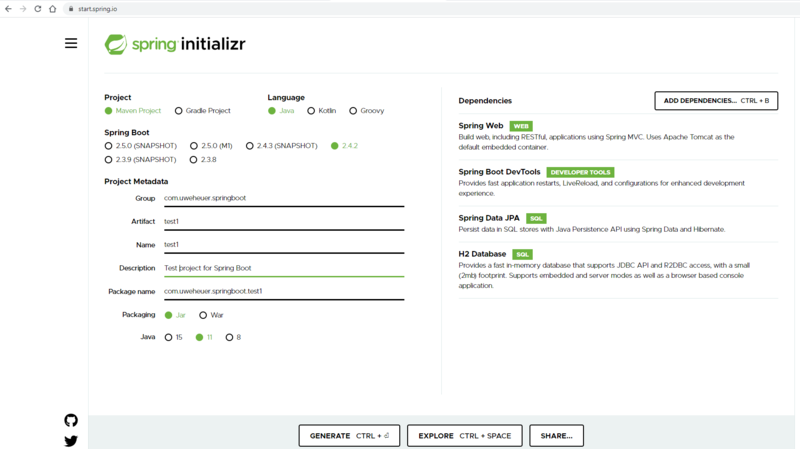
- create app with Sprint Initialzr
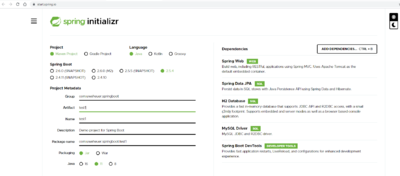
- copy test1.zip to
C:\Uwes\eclipse\workspace_2020-12\SpringBoot - extract it, which creates a test1 directory
- import as Maven project and select root directory

Test2
- for Raspberry
- export productive DB content of DB mysql506 via https://uweheuer.spdns.de/phpxmyadmin to C:\Uwes\Backup\Raspberry (incl. drop statements)
- import after starting xampp via http://localhost:8090/phpmyadmin
Then
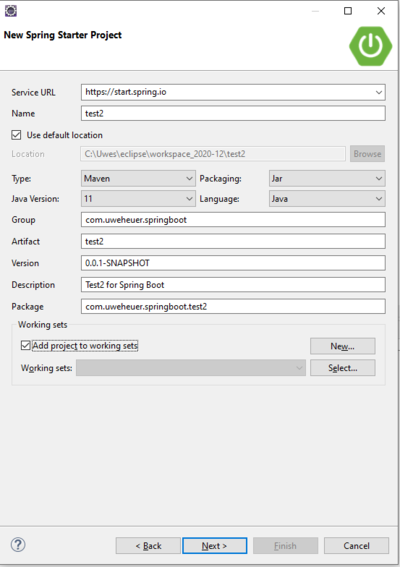
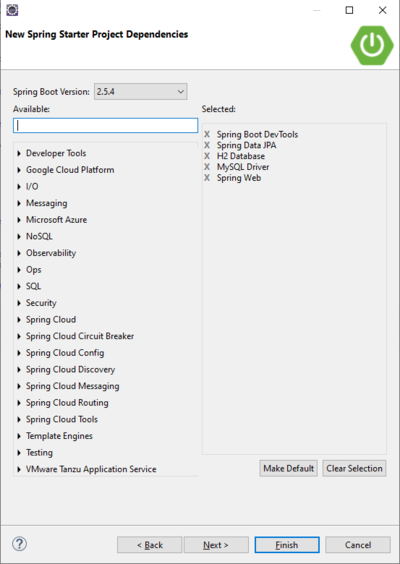
- use wizzard of Eclipse Spring Tools
- File -> New -> Other -> Spring Starter Project
- in order to use JPA Tools (according to here) right click project -> Configure -> Convert to JPA Project
- RC project -> JAP Tools -> Generate entities from tables
- Run As 'Spring Boot App'


Test3
- creation with eclipse wizzard like Test 2
Udemy Course
- start eclipse
- File -> Import -> Maven Project

Bookmarks
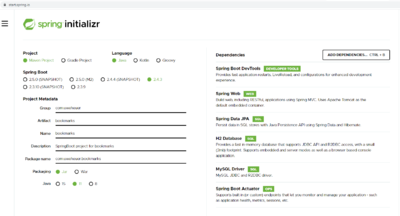
- start eclipse
- File -> Import -> Maven -> Existing Maven Projects
- select
C:\Uwes\eclipse\workspace_2020-12\SpringBoot\bookmarks

Database Configuration
The default is that the datasource url is generated randomly and printed to the console. The default user is 'sa', default password is empty.
spring.profiles.active=[dev|laptopmysql|raspberry]
- and created in
\bookmarks\src\main\resources\dedicated property filesapplication-[dev|laptopmysql|raspberry].properties
H2 Database Configuration
- see
application-dev.properties
# to make the h2 database url constant, otherwise it is a random url
spring.datasource.url=jdbc:h2:mem:bookmarksdb
# user and password for H2 console
spring.datasource.username=uwe
spring.datasource.password=uwe
Test Data for Startup
- in
<PROJECT_DIR>/src/main/resources/data.sql
Links
- see My Bookmarks -> Web-Präsenz -> localhost -> SpringBoot -> Bookmarks
ToDos
- JSON rest APIs
- adjust maven build
- build entities
- The @ManyToOne association uses FetchType.LAZY because, otherwise, we’d fall back to EAGER fetching which is bad for performance.
- https://thorben-janssen.com/ultimate-guide-derived-queries-with-spring-data-jpa/ Query Documentation]
- Sorted Lists
- http://assarconsulting.blogspot.com/2009/08/why-hibernate-does-delete-all-then-re.html
- https://stackoverflow.com/questions/13101882/jpa-onetomany-list-vs-set/29562678
- https://www.google.com/search?q=jpa+onetomany+list+or+set&rlz=1C1GCEU_deDE848DE867&ei=-iFTYO3XHJWj1fAPw5mgqAM&oq=JPA+%40one2many+list&gs_lcp=Cgdnd3Mtd2l6EAEYATIGCAAQFhAeMgYIABAWEB4yBggAEBYQHjIGCAAQFhAeMgYIABAWEB4yBggAEBYQHjIGCAAQFhAeMgYIABAWEB4yBggAEBYQHjIGCAAQFhAeOgcIABBHELADOggIABAWEAoQHlDLIViCJWC1UmgCcAJ4AIABhgGIAdkDkgEDNC4xmAEAoAEBqgEHZ3dzLXdpesgBCMABAQ&sclient=gws-wiz
- Sorted Lists